
When Anthropic built their research functionality, they faced a problem familiar to every AI team: asking a single agent to handle complex research tasks is like asking one person to simultaneously be a world-class researcher, fact-checker, and writer. The results are often inconsistent and frequently miss critical insights.
What was their solution? Multiple Claude agents working collaboratively—one responsible for planning research strategy, others gathering information in parallel, and finally one agent synthesizing everything into a comprehensive report. This multi-agent workflow approach revolutionized their research capabilities.
However, as we move from technical architecture to practical application, a deeper question emerges: How can non-technical users easily harness these powerful multi-agent capabilities like commanding a professional team?
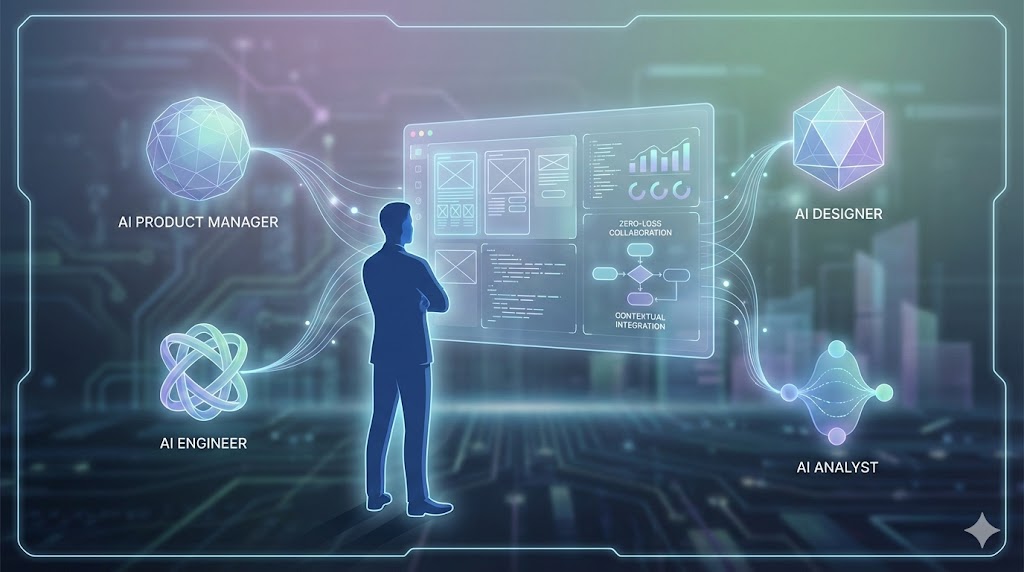
This is precisely the core problem that Paiteams—AI Agent Collaborative Workspace aims to solve. We are not a single-point AI tool or chatbot. Our core is a new-generation productivity platform that seamlessly connects and collaborates multiple AI agents with professional service capabilities and humans through a unified workspace to ultimately deliver complex tasks.
"A workbench that lets you, like a boss, command different AI experts (such as analysts, programmers) at any time, seamlessly collaborate on the same project, and deliver complete results."
Market Positioning: Filling the Gap in Existing Solutions
Currently, there is no identical product in the market, but four related product categories collectively define our reference framework:
-
Multi-agent frameworks and orchestration tools: Such as AutoGen, CrewAI, Coze. These are code-driven multi-agent orchestration frameworks or tools for developers, emphasizing automated processes but lacking out-of-the-box user experience and collaborative space.
-
AI-enhanced collaboration tools: Such as Notion AI, Coda AI. They integrate AI capabilities into documents/spreadsheets, but AI serves as a general assistant role, not as customizable, on-demand multiple professional agents.
-
Single-agent platforms: Such as ChatGPT, Claude. They provide powerful general conversation or custom GPTs, but essentially are "one AI". Users need to manually switch and paste in complex tasks, acting as the "information glue."
-
Professional vertical AI services: Such as AI products focused on specific domains. They typically focus on specific areas (like AI design, AI programming), providing end-to-end automated solutions, but lack the ability for humans and AI teams to communicate multi-round and deeply engage throughout the project lifecycle.
Our fundamental difference lies in "organizing an AI professional service team centered on seamless collaboration":
| Comparison Dimension | Multi-Agent Frameworks (e.g., AutoGen) | AI Collaboration Tools (e.g., Notion AI) | Professional Vertical AI Services | Paiteams |
|---|---|---|---|---|
| Core Logic | Automated processes (code orchestration) | Enhancing individual capabilities (document assistance) | Single-domain automated delivery | Controllable, high-quality delivery (human commands, AI team executes) |
| User Experience | Developer-friendly, high technical barrier | Document-centered, AI as copilot | Submit requirements, wait for results | Zero-threshold workspace with "@ to invoke, block to collaborate" |
| Agent Role | Programmable "workflow nodes" | General "assistant" | Domain-specific "full-stack expert" | Independent, professional "expert members" that can join projects anytime |
Core Advantages: Paradigm Shift from "Tool Usage" to "Team Collaboration"
There are indeed many "AI expert" or "multi-agent" products today. Our core difference is not in "quantity," but in the collaboration model and workflow nature. Most similar products fall into one of three modes:
-
"Fully Automated Assembly Line" mode: Input goal, AI executes automatically to the end, user is the "boss issuing commands"
-
"Multiple Solo Soldiers" mode: Provide multiple different AI tools, but require users to act as "project manager"
-
"Vertical Expert Tool" mode: Focus on specific professional domains, lack cross-domain integration capability
Our core advantage is: providing a "human-AI hybrid elite war room":
| Comparison Dimension | Common "AI Expert Teams" | Paiteams | Value to Users |
|---|---|---|---|
| Collaboration Mode | AI automatic execution or solo operation | "Human commands, AI team collaborates and executes" | User is the director, with full control and improvisation space |
| Work Interface | Scattered chat windows or black-box backend | Unified shared-context workspace | All AI members' work appears in real-time on the same document/conversation |
| Deliverables | Intermediate products or final products requiring extensive integration | End-to-end, ready-to-use/fine-tunable deliverables | Out-of-the-box, reducing the last-mile workload from "AI output" to "usable results" |
One-sentence summary of the difference: Others let AI work automatically or give you a bunch of AI tools. We enable you to work consultatively and collaboratively with a well-coordinated AI team in one room to get the job done.
Target Users and Core Scenarios
We currently focus intensely on two core target user groups, solving their most urgent efficiency bottlenecks:
First Category: Builders Who Need "Rapid Idea Validation"
-
Who they are: Startup founders, independent developers, product managers, marketers
-
Pain points: To validate an idea, even creating a demo website or landing page requires finding designers and front-end developers, taking days or even weeks
-
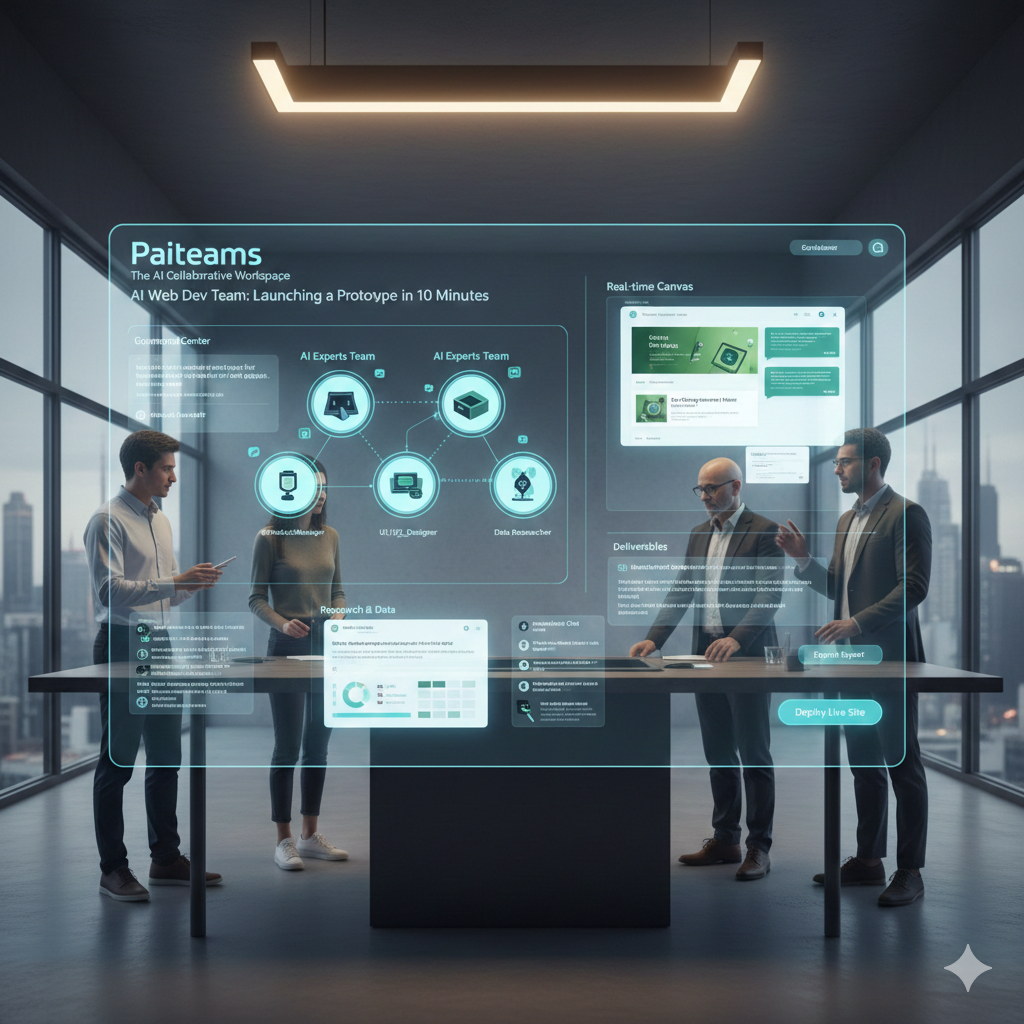
Our solution: AI Web Development Team
-
Users describe requirements in natural language, AI team (product, design, development) collaborates in unified space
-
Generate an accessible, functional website with basic features in about 10 minutes
-
Shorten the cycle from "idea → interactive prototype" from days to minutes
-
Second Category: Analysts Who Need "Quick Understanding of Unfamiliar Domains"
-
Who they are: VCs, industry analysts, strategy consultants, market researchers
-
Pain points: When entering a new industry or researching a company, they need to investigate, organize, and integrate massive information into insightful reports
-
Our solution: Deep Research Team
-
Users input a company name or industry keyword, AI team (information retriever, analyst, chart expert, writer) collaborates
-
Produce a structured draft report with overview, track, competition, trends, etc. in about 1 hour
-
Transform the process from "unfamiliar domain → structured understanding" from "solo grinding for days" to "collaborative梳理 with AI team for one hour"
-
Shared Deep Pain Point and Value: The shared pain point of these two user groups is that "complex tasks require multiple professional capabilities, but individual time and energy are limited, or coordinating multi-person collaboration is costly." What we provide is not "another AI chat box," but a "plug-and-play professional capability expansion pack" and a "zero-loss war room for collaboration."
Technical Architecture: Integrating Best Practices, User Experience-Focused
In technical implementation, we draw on best practices from multi-agent systems, but always reconstruct with user experience as the center:
1. Intelligent Communication Pattern Adaptation
-
Shared workspace model: All agents work on the same "virtual whiteboard," ensuring complete context synchronization
-
Intelligent handover mechanism: Automatically choose between "full transparency" or "results handover" mode based on task complexity
-
Human-in-the-loop design: Users can intervene, adjust, and provide feedback at any node
2. Modular Agent Design
Each professional agent possesses:
-
Dedicated role and responsibility: Such as "Front-end Development Expert," "Industry Analyst," "UI Designer"
-
Custom prompt engineering: Instruction sets and thinking frameworks optimized for professional domains
-
Toolchain integration: Access to necessary APIs, databases, and professional software
-
State memory: Maintain consistency within sessions, learning user preferences and styles
3. Unified Workspace Architecture
-
Project-centered: Each task is an independent "project space"
-
Real-time collaborative view: All agent outputs appear in real-time, supporting user comments and edits anytime
-
Version control: Complete recording of every modification and decision process
-
Deliverable management: Final outputs are automatically organized and packaged, supporting one-click deployment/export
Implementation Path: From Proof of Concept to Scale
Based on our platform practice, we've summarized the key steps for multi-agent system deployment:
-
Scenario Definition and Deconstruction
-
Identify high-value, standardizable complex tasks
-
Break down tasks into clear sub-tasks and decision points
-
Define quality standards and acceptance criteria for each stage
-
-
Agent Team Formation
-
Configure professional agent combinations based on task requirements
-
Design collaboration protocols and communication specifications between agents
-
Establish human supervision and intervention access points
-
-
Workflow Orchestration and Optimization
-
Adopt hybrid control flow: preset main process + dynamic branch adjustment
-
Implement state persistence, supporting long-running tasks
-
Built-in A/B testing framework, continuously optimizing agent performance
-
-
User Experience Design
-
Minimize learning curve: natural language input, intuitive visual interface
-
Provide process transparency: real-time view of each agent's thinking and work progress
-
Support progressive complexity: start from template tasks, gradually support custom workflows
-
-
Scaled Deployment
-
Agent pool management: on-demand scheduling, load balancing
-
Cost optimization: match most cost-effective models for different tasks
-
Monitoring and alerting: real-time tracking of system health and task success rates
-
Future Outlook: From Tool to Ecosystem
The development of multi-agent collaborative workspaces will go through three phases:
Phase 1: Professional Service Teams (Current)
-
Focus on vertical scenarios, providing out-of-the-box AI expert teams
-
Solve the "last-mile" problem: from AI capability to actually usable deliverables
Phase 2: Custom Team Building
-
Users can compose their own teams from an agent marketplace based on needs
-
Support workflow customization and agent fine-tuning
-
Form a two-sided market of agent developers and users
Phase 3: Autonomous Organization and Evolution
-
Agents can autonomously recruit collaboration partners
-
System optimizes team composition and workflows based on historical data
-
Form self-evolving intelligent organizational entities
Conclusion: Redefining the Boundaries of Human-AI Collaboration
Multi-agent workflows represent an important evolution of AI applications from "all-in-one assistant" to "professional team." However, technological progress must be synchronized with user experience innovation.
Paiteams's core philosophy is: The true productivity revolution is not about AI replacing humans, nor humans adapting to machine logic, but creating a new type of collaboration interface—where humans contribute creativity, judgment, and decision-making, AI provides professional capabilities, execution power, and scale advantages, and both sides seamlessly collaborate in a shared context.
When every creative can assemble a cross-domain professional team in minutes, when every decision-maker can obtain deeply customized analytical support within hours, when the delivery cycle of complex tasks shortens from days to hours—we believe this is not just an efficiency boost, but a liberation of creativity and reshaping of organizational forms.
The future of multi-agent collaboration has arrived, and its true potential lies in enabling everyone to command their own AI expert team, turning ideas into reality rapidly.