
From Chatbots to Autonomous Agents: The Dawn of the Agent Economy in 2026
The Evolution of AI: Beyond Conversation to Execution
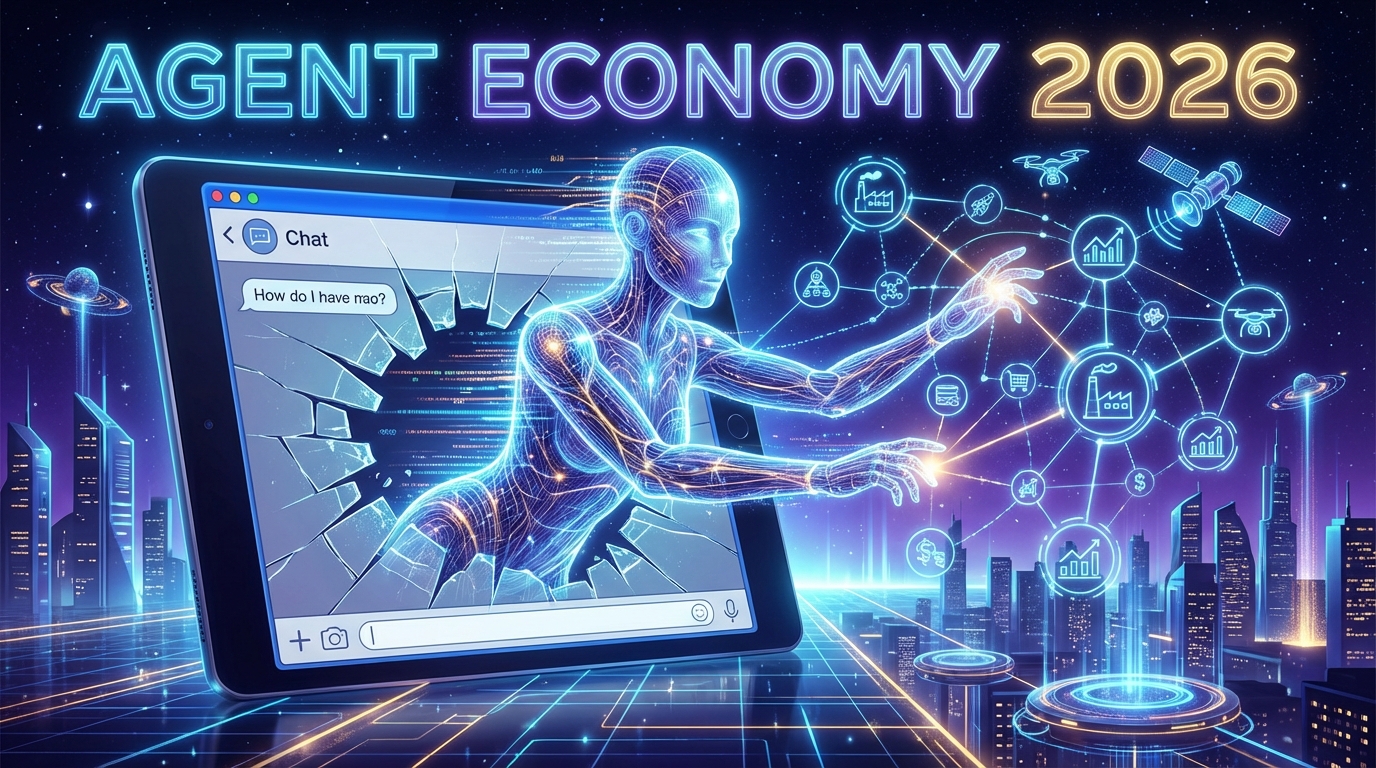
The year 2026 marks a pivotal moment in the evolution of Artificial Intelligence. What began with conversational chatbots and sophisticated language models is now rapidly transitioning into an era of Agentic AI—systems capable of not just understanding and generating human-like text, but also reasoning, planning, and autonomously executing complex tasks. Multiple market reports, including those from The Business Research Company, are highlighting the explosive growth of the "Agentic AI" market, signaling a fundamental shift in how AI interacts with the world 1. AI is moving beyond the chat window and into the realm of active execution.
The Agentic Leap: Reasoning and Autonomy
The defining characteristic of Agentic AI is its ability to perform tasks with a high degree of autonomy. Unlike their predecessors, these agents can break down complex goals into sub-tasks, make decisions, learn from their environment, and adapt their strategies to achieve objectives without constant human intervention. This leap in capability is driven by advancements in reasoning capabilities, allowing AI to process information, infer logical conclusions, and plan multi-step actions in dynamic environments. The implications are profound, paving the way for AI systems that can manage projects, conduct research, and even operate entire business processes.
Autonomous Enterprise Systems: The Future of Business Operations
The rise of Agentic AI is directly fueling the development of Autonomous Enterprise Systems. Businesses are beginning to deploy AI agents that can independently handle a wide array of operational functions, from optimizing supply chains and managing customer service interactions to performing financial reconciliations and automating complex data analysis. This shift promises unprecedented levels of efficiency, accuracy, and scalability, allowing human employees to focus on higher-value, strategic initiatives. The vision of a truly autonomous enterprise, where AI agents seamlessly collaborate to drive business outcomes, is rapidly becoming a reality.
Sovereign AI and the Regulatory Horizon
As Agentic AI systems gain more power and autonomy, critical discussions are emerging around Sovereign AI and regulation. The question of how to ensure these powerful agents operate within ethical and legal frameworks is a pressing concern in both Europe and the United States. Topics such as data privacy, accountability for autonomous decisions, and the potential for unintended consequences are at the forefront of regulatory debates. The challenge lies in fostering innovation while simultaneously establishing robust governance mechanisms to ensure AI serves humanity responsibly.
The Promise of the Agent Economy: A Glimpse into the Future
The Agent Economy envisions a future where AI agents are not just tools but active participants in economic activities, capable of creating value, engaging in transactions, and even forming their own markets. This paradigm shift holds immense potential for innovation and economic growth.
| Feature | Description | Impact |
|---|---|---|
| Task Automation | AI agents autonomously complete complex, multi-step tasks. | Increased efficiency, reduced operational costs, faster execution. |
| Personalized Services | Agents learn user preferences to deliver highly customized experiences. | Enhanced customer satisfaction, new service models. |
| Resource Optimization | AI agents manage and allocate resources (e.g., energy, computing) intelligently. | Sustainable operations, improved resource utilization. |
| Decentralized Operations | Agents can operate independently or in networks, reducing central control. | Increased resilience, new forms of collaboration. |
Elon Musk and the Vision of Space Computing:
Adding another layer to this futuristic vision, Elon Musk recently posited that space-based computing power could become more efficient than Earth-based systems within three years 2. This bold prediction suggests a future where AI models, particularly those powering advanced agents, might leverage orbital infrastructure for enhanced performance and reduced latency. Such a development could further accelerate the capabilities and deployment of Agentic AI, pushing the boundaries of what autonomous systems can achieve.
Conclusion
The year 2026 is indeed the dawn of the Agent Economy. The transition from chatbots to truly autonomous AI agents capable of reasoning and execution is reshaping industries and redefining the future of work. While challenges related to regulation and ethical governance remain, the potential for increased efficiency, innovation, and entirely new economic models is undeniable. For tech enthusiasts and innovators, understanding Agentic AI is not just about staying current; it's about preparing for a future where intelligent agents are integral to every facet of our lives.
References
[1] The Business Research Company, "Agentic AI Tools Global Market Report 2026," March 2026.
[2] Azernews.az, "Elon Musk: AI computing will be cheaper in space within 3 years," March 23, 2026.