
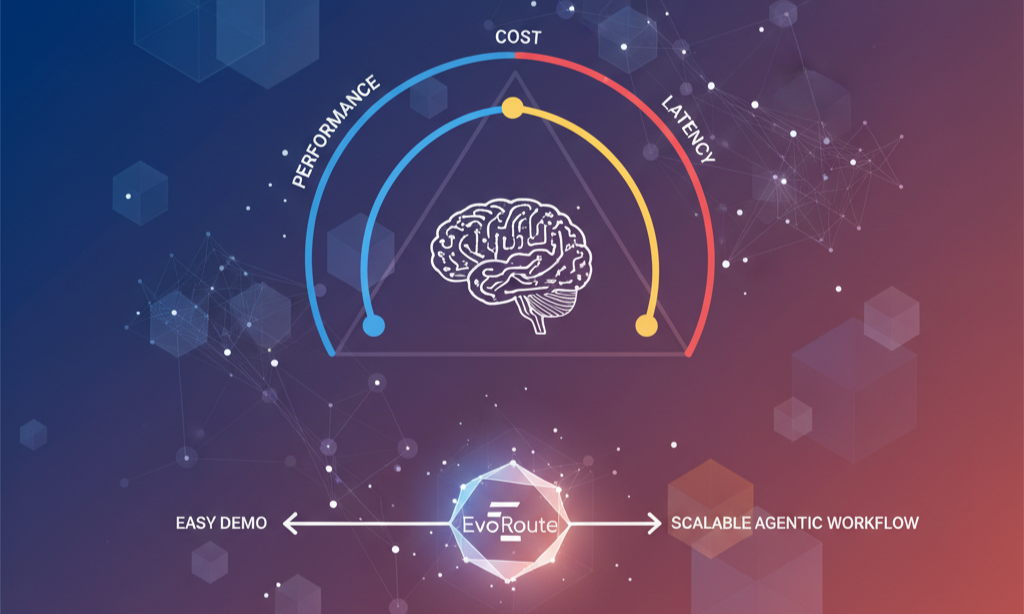
In the era of Generative AI, building a demo is easy, but building a scalable, commercially viable agentic workflow is an engineering challenge of the highest order.
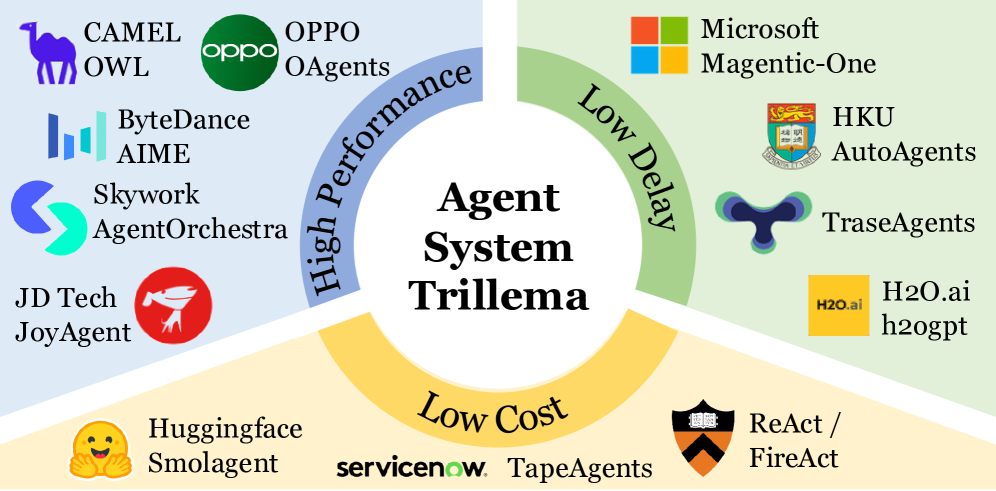
At Paiteams, our mission is to seamlessly integrate AI agents into your daily workflow through our "Note + Agent" architecture. When a user tags @DeepResearch or @WebDev, they expect magic. However, behind the scenes, we face what researchers call the "Agent System Trilemma."
We cannot simply maximize Performance without exploding Cost or introducing unacceptable Latency.
Today, we are sharing insights into a routing paradigm that is shaping our thinking: EvoRoute (Experience-Driven Self-Routing LLM Agent Systems). This approach moves beyond static model selection to a dynamic, self-evolving system that balances the trade-offs of AI orchestration.
The Challenge: One Model Does Not Fit All
In a complex workflow—such as generating a full product requirements document—not every step requires "PhD-level" intelligence.
- Planning and Reasoning require state-of-the-art models (e.g., GPT-4, Claude 3.5).
- Data Formatting and Simple Execution can often be handled by smaller, faster, and cheaper models (e.g., Llama 3, Haiku).
The traditional approach of routing all tasks to the smartest model is economically inefficient. Conversely, routing to smaller models degrades quality. We need a system that knows when to use which tool.
The Solution: EvoRoute's Architecture
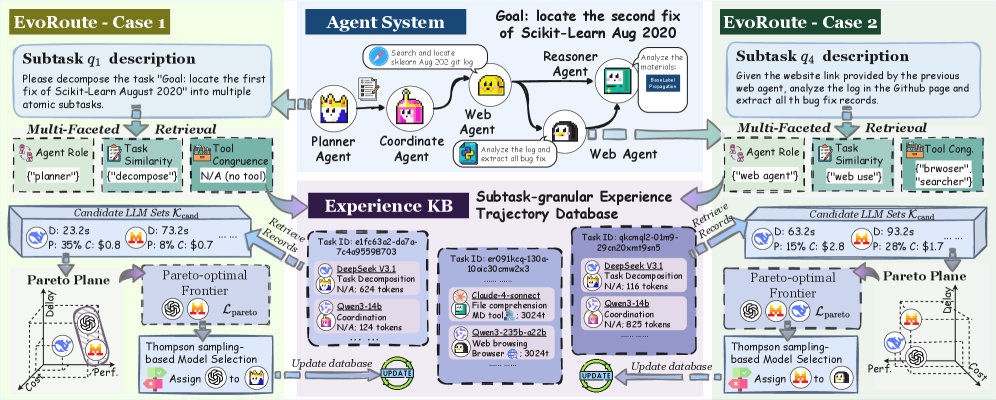
EvoRoute introduces a self-evolving model routing paradigm that breaks the trilemma by dynamically selecting the optimal LLM at the fine-grained subtask level.
The architecture operates in three sophisticated stages:
1. Multi-Faceted Retrieval
Instead of treating every query as new, the system looks at the past. It retrieves historical data based on:
- Agent Role: What did the
@Coderagent do successfully last time? - Semantic Similarity: Have we seen a similar task instruction before?
- Tool Consistency: Does this task require external tools (like browsing or Python execution)?
2. Pareto-Optimal Filtration
This is where the engineering rigor comes in. The system evaluates candidate models based on three metrics: Performance (Success Rate), Cost, and Efficiency (Time). It filters out any model that is "dominated" (i.e., worse in all aspects) by another, leaving a set of Pareto-optimal choices.
3. Thompson Sampling Selection
To avoid getting stuck in a local optimum (always picking the same "safe" model), the system uses Thompson Sampling. It models the uncertainty of each choice and samples from a probability distribution. This allows the system to "explore" potentially better model combinations while primarily "exploiting" known successful paths.
The Impact: Experience-Driven Efficiency
The core innovation here is the Self-Evolving Experience Pool. The system gets smarter and cheaper the more it is used.
In benchmark tests (such as GAIA and BrowseComp+), this routing approach demonstrated stunning results compared to static baselines:
- Cost Reduction: Up to 80% decrease in operational costs.
- Latency Improvement: Over 70% reduction in execution time.
- Performance: Maintained or even exceeded the success rate of using SOTA models exclusively.
For example, on the GAIA benchmark, the system matched the performance of top-tier models but slashed the cost from $359.32 to just $85.40.
What This Means for Paiteams Users
At Paiteams, we believe that the marginal cost of intelligence must trend toward zero for AI to become a true collaborative partner.
By implementing intelligent routing logic inspired by architectures like EvoRoute, we ensure that when you use Paiteams:
- Complex tasks get the deep reasoning power they need.
- Routine tasks happen instantly and affordably.
- The System Evolves: Your workspace learns from your workflows, becoming more efficient over time.
We are not just building a chat interface; we are building an adaptive intelligence infrastructure.
Read the full research paper on EvoRoute for a deeper dive into the mathematics of self-routing systems.
Read the full paper here.